Powered by RedCircle
Burnout and cortisol searches are at all-time highs in 2026. Here’s a 20-minute nervous-system reset routine that HR leaders can bring to their teams today.
Search data doesn’t lie. In 2026, “burnout at work,” “feel overwhelmed,” and “stress relief” are all being searched at all-time highs. Cortisol — the body’s primary stress hormone — has seen search interest nearly double since January alone, hitting a record high for the third consecutive month.
This is not a personal wellness problem. It is an organizational performance crisis.
For HR Directors, People & Culture leaders, and those responsible for workforce well-being, the question is no longer *is* your workforce stressed — it’s what are you going to do about it that actually works.
In this post, you’ll learn:
- Why the 2026 burnout and cortisol data should be on your leadership radar
- How the nervous system actually responds to chronic workplace stress
- Reset Your Nervous System: A research-informed 20-minute daily regulation routine you can introduce to your teams
- How to embed this practice into your existing wellness and L&D strategy
The 2026 Burnout Signal Is Too Loud to Ignore
The numbers coming out of search trend analysis this year paint a clear picture of a workforce under significant physiological strain.
“Burnout at work” and “burnout from life” are at all-time highs. “Occupational stress” has reached a 15-year peak. “Low stress jobs” is being searched more than ever before — a signal that employees are not just fatigued, they are actively looking for exits. “Burnout retreats” broke out as a new search trend this past month, and “burnout therapy” hit its highest recorded search volume this year.
Parental burnout is compounding the picture. Searches for “parental burnout,” “single parent burnout,” and “default parent burnout” all reached all-time highs — a reminder that the people on your teams carry pressures that extend well beyond the office.
Cortisol data tells an equally urgent story. Interest in high cortisol symptoms, cortisol-triggering foods, and cortisol testing has surged across the country. People are not just stressed — they are aware that their stress is biologically measurable, and they are searching for answers.
The question your organization needs to be asking is not whether to invest in nervous system health. It is how.
What Chronic Stress Actually Does to a Team
Understanding *why* this matters for organizational performance requires a brief but important look at the biology.
When the nervous system perceives threat — whether that is a performance review, an unrealistic deadline, or a difficult team dynamic — the limbic system triggers a stress response. Cortisol and adrenaline flood the body. The prefrontal cortex, responsible for strategic thinking, decision-making, and emotional regulation, essentially goes offline.
This is not a character flaw. It is neuroscience.
Search trends reflect this reality: “emotional flooding” has doubled in searches in 2026, and “overwhelmed vs overstimulated” is being searched at twice the rate it was last year. Employees are trying to understand what is happening in their own bodies because their organizations have not yet given them the language — or the tools — to address it.
Chronic activation of the stress response leads to cognitive fatigue, reduced creativity, poor interpersonal communication, absenteeism, and ultimately, turnover. The cost of replacing a single employee ranges from 50% to 200% of their annual salary. Nervous system regulation is not a soft skill. It is a retention and performance strategy.
The Science Behind Nervous System Regulation
Effective nervous system regulation works across three interconnected systems that are frequently disrupted by chronic workplace stress.
- **The Limbic System** governs the brain’s threat-detection and emotional processing. When dysregulated, employees are reactive, emotionally flooded, and unable to access higher-order thinking. Grounding techniques that signal environmental safety directly calm limbic activation.
- **The Vestibular System** — the inner ear’s balance and spatial orientation mechanism — is deeply connected to anxiety and hypervigilance. Vestibular dysregulation often presents as difficulty concentrating, sensitivity to light and sound, and a persistent sense of unease. Targeted vestibular exercises improve the Vestibulo-Ocular Reflex (VOR) and reduce ambient anxiety.
- **The Visual System** is a primary input channel to the nervous system. Gaze stabilization and smooth pursuit exercises have been used in trauma therapy and vestibular rehabilitation to reduce sympathetic nervous system activation and improve focus.
The routine outlined below integrates all three systems in a sequenced 20-minute practice, designed to be accessible without any equipment, specialized training, or clinical background.
The 20-Minute Nervous System Reset Routine
This routine is designed to be performed twice daily — once in the morning to prime the nervous system for focused, regulated work, and once in the evening to down-regulate before rest. It can be introduced as a guided team practice, included in wellness programming, or shared as a self-directed employee resource.
Phase 1: Limbic Grounding & Centring — 5 Minutes
The goal of this phase is to signal safety to the brain’s emotional center before adding any physical demand.
- **Orienting to Safety** Slowly scan the immediate environment and identify three specific colours and two textures. This deceptively simple exercise activates the parasympathetic nervous system by engaging the brain’s environmental mapping function — a direct signal to the limbic system that no immediate threat is present.
- **The Voo Breath.** Inhale deeply, then exhale while producing a sustained, low-pitched “Voooo” sound. The vibration directly stimulates the vagus nerve, the primary pathway of the parasympathetic nervous system, shifting the body from sympathetic activation (fight-or-flight) toward parasympathetic recovery (rest-and-digest). Vagal tone is increasingly recognized as a biomarker of stress resilience.
- **Self-Soothing Touch.** Place one hand on the heart and one on the belly. Hold this position for one to two minutes while attending to the breath. This activates the tactile nervous system and, through the heart-brain connection, begins to regulate heart rate variability (HRV) — another key indicator of stress resilience.
Phase 2: Visual & Vestibular Coordination — 10 Minutes
The goal of this phase is to improve vestibular-ocular integration, which is frequently compromised by screen-heavy, sedentary work environments.
- **Gaze Stabilization (VOR x1)** Hold a printed letter “E” at eye level. While keeping the eyes locked on the letter, slowly rotate the head in a “no” motion for 30 seconds, then a “yes” motion for 30 seconds. The objective is to maintain a crisp, clear image throughout. Blurring indicates vestibular-ocular dysregulation and is the signal to slow down, not push through.
- **Saccades — Rapid Eye Shifts** Hold two index fingers approximately 12 inches apart. Rapidly shift the gaze from one fingernail to the other without any head movement. Complete 20 repetitions. Saccadic eye movement training is used in both vestibular rehabilitation and concussion recovery protocols, and has been shown to improve attentional control.
- **Smooth Pursuit** Slowly move one finger in a large H or X pattern in front of the face. Track the movement with the eyes only, keeping the head completely still. Smooth pursuit exercises train the visual cortex and reduce visual fatigue — a significant contributor to cognitive overload in screen-intensive work environments.
- **Head Nods & Turns with Eyes Closed** In a seated position, slowly rotate the head side-to-side 10 times, then nod up and down 10 times with eyes closed. Removing visual input forces the vestibular system to function independently, building proprioceptive confidence and reducing anxiety responses tied to sensory overwhelm.
Phase 3: Dynamic Integration & Proprioception — 5 Minutes
The goal of this final phase is to reintegrate the now-regulated sensory systems with the physical body.
- **The Arch and Flatten** Lying on the back, inhale and gently arch the lower back off the floor, then exhale and press it flat. This spinal mobilization exercise resets the relationship between the spine and the ground, releases held tension in the lumbar region, and reinforces breath-movement coordination.
- **Heel-to-Toe Stance** Standing near a wall, place one foot directly in front of the other in a tightrope position and hold for 30 seconds. For a progression, add slow head turns while maintaining the stance. This balance exercise challenges proprioception and vestibular function simultaneously, building the neurological foundations of physical groundedness.
- **Shaking Out Tension** Stand and gently shake the hands, arms, and legs for one minute. This practice — grounded in Somatic Experiencing and trauma-informed body work — discharges residual muscular tension and completes the body’s natural stress response cycle. Animals in the wild do this instinctively following a stress event. Humans rarely do.
How HR Leaders Can Implement This in Practice
The value of this routine lies not just in its physiological efficacy, but in its organizational scalability. Consider the following implementation pathways.
- **As a Team Opening Practice** Introduce a condensed version of Phase 1 (five minutes of limbic grounding) at the start of team meetings, workshops, or training sessions. Research consistently shows that regulated nervous systems produce better collaborative outcomes.
- **Within Existing Wellness Programming** Package the full 20-minute routine as a guided audio or video resource within your employee wellness portal. Pair it with education on cortisol, burnout biology, and stress resilience to build health literacy alongside the practice.
- **In Leadership Development** Leaders who can regulate their own nervous systems model psychological safety for their teams. Incorporating somatic and nervous system regulation content into your L&D programming is a meaningful differentiator — and an increasingly expected one.
- As Part of Return-to-Work or Burnout Recovery Support** For employees returning from stress leave or navigating burnout recovery, a structured nervous system regulation practice offers a non-clinical, self-directed bridge to sustained well-being.
**Safety Note for All Contexts:** If any exercise causes a sudden increase in dizziness or nausea, participants should stop immediately and rest. This routine is not a substitute for clinical care in cases of diagnosed vestibular disorders or trauma. Encourage employees to consult their healthcare provider if symptoms are significant.
Key Takeaways for People Leaders
- The 2026 data on burnout, stress, and cortisol is not background noise. It is a direct signal about the physiological state of your workforce — and by extension, your organizational capacity.
- Nervous system regulation is evidence-informed, scalable, and cost-effective. It does not require significant budget, specialized equipment, or clinical expertise to introduce. What it does require is leadership commitment to the idea that human biology is a legitimate organizational concern.
- The teams that will outperform in the next five years will not just be the most skilled. They will be the most regulated — capable of sustained focus, emotional intelligence, and adaptive resilience under pressure.
That starts with 20 minutes a day.
We have created a complete video guide and slide deck that walk through all 10 exercises, with instructions, visual demonstrations, and implementation tips.
- Watch the Nervous System Reset routine on YouTube
- Download the Exercise Card Set
- Listen to the Audio Version on The ChangeMaker Podcast
About our Founder:
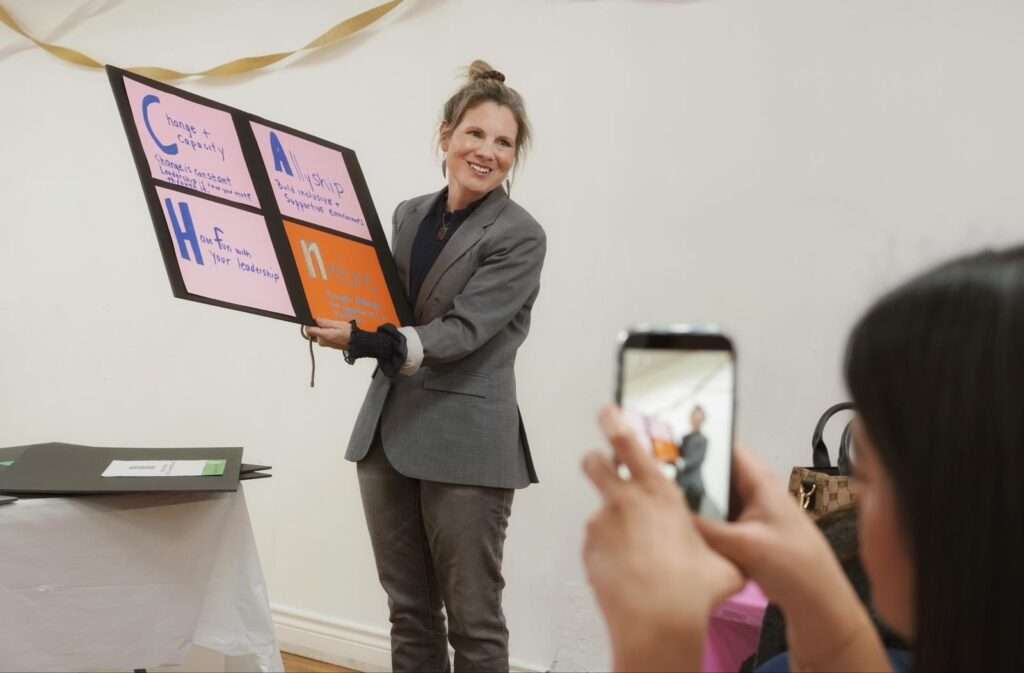
Leigh Mitchell is a Leadership Brand Strategist, educator, and Founder of Women in Biz Network, helping Impact Leaders build high-performing, people-first organizations. She teaches at York University and the University of Guelph-Humber and consults with corporate partners, including Microsoft Canada, TELUS, and TD Canada Trust.
- Connect with Trainer & Leadership Brand Consultant Leigh Mitchell on LinkedIn now
- Work or get Leigh -Training & Consulting
- Get Information on Women in Biz Network Career Board & Services